

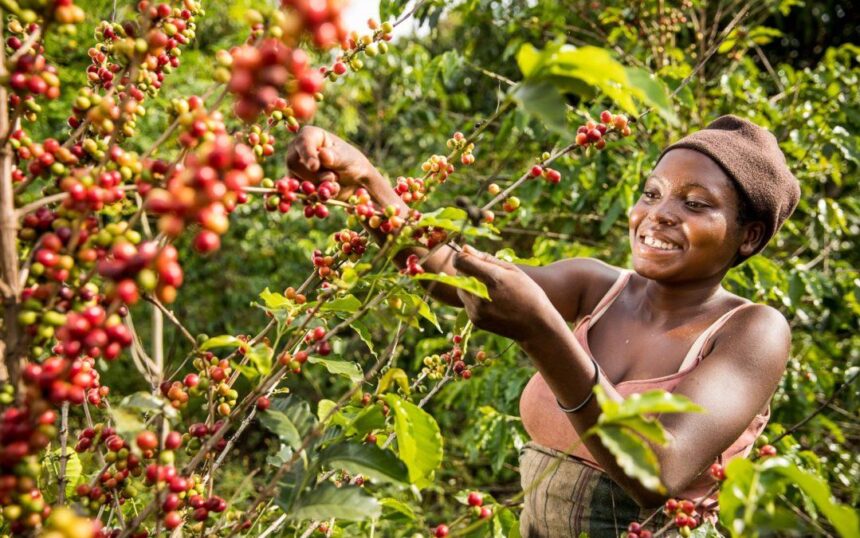
Coffee refers to both the beverage brewed from roasted and ground coffee beans and the coffee plant species, specifically Robusta and Arabica varieties that are grown in the country, while Arabica coffee production is smaller and primarily occurs in highland areas on the slopes of mountains. The main regions known for Arabica cultivation are Mount Elgon in the east, the Rwenzori Mountains in the southwest, and the West Nile region in the northwest. Specifically, the slopes of Mount Elgon, mainly the Bugisu region, are famous for Arabica production.
The Rwenzori Mountains, also known as the “Mountains of the Moon”, are another significant area for Arabica, with coffee grown at elevations between 1,500 and 2,300 meters. Additionally, some Arabica is grown in the West Nile region. Coffee in Uganda is characterized by Robusta dominance. The country is renowned for its Robusta coffee, which is native to the country and grows wild in rainforests. Robusta beans are known for their high caffeine content, strong flavor, and resilience to disease.
Arabica cultivation is grown in the highland regions, particularly around Mount Elgon, the Rwenzori Mountains, and the West Nile region. Uganda produces both robust varietals like Nganda and Erecta and Arabica varietals like Typica, SL 14, SL 28, and Kent. It is a major economic export crop for Uganda, contributing significantly to the country’s foreign exchange earnings.
Uganda is ranked 8th in the world for its coffee production. The Robusta plant is native to Ugandan soils, something that you wouldn’t find in many coffee-growing nations across the globe. Therefore, it has a longstanding history of being one of the most intensively farmed crops. In fact, it is a source of livelihood for as many as 1.7 million smallholder farmers.
Coffee has significantly benefited Uganda’s economy in different ways: It Contributes nearly a third of Uganda’s export earnings, Uganda Coffee Export Highlights (2024–2025)
In the financial year 2023/2024, the estimated export volume was 6.13 million bags valued at $1.14 billion; there was a growth in value of 35.29% from the previous year.
In the period between Feb 2024 and Jan 2025, the export volume was estimated at 6.44 million bags at a value of $1.62 billion. There was an increment of 64.47% from the previous year.
The latest figures stand at 6.57 million bags as of Feb 2025 at a cost of $1.72 billion, a percentage increase of 70.71% from the previous year.
The key drivers of coffee growth in Uganda are high global coffee prices due to supply constraints in Brazil and Vietnam, government initiatives like free seedling distribution and improved post-harvest handling, strong demand from Europe (especially Italy), Asia, and North America, and private sector investment in especially Arabica and Robusta processing. Uganda has now overtaken Ethiopia to become Africa’s top coffee exporter, earning $1.97 billion from coffee exports in the past year.
It has greatly eradicated poverty and improved livelihoods in Uganda today. Studies have shown that coffee-producing households have a lower poverty incidence (21.7%) compared to non-coffee-producing households (31.6%). Coffee production has also increased ownership of household assets like bicycles, motorcycles and mobile phones. It has also improved employment and livelihoods. It supports around 1.7 million smallholder farmers, with approximately 1.8 to 2.2 million households relying on coffee as a primary source of cash income.
This translates to about 25% of Uganda’s population depending directly or indirectly on the coffee value. Uganda is promoting sustainable coffee farming practices, including shade-grown coffee, organic farming, and agroforestry. These practices not only enhance biodiversity but also contribute to carbon sequestration, with shade-grown coffee capturing 5-10 tons of CO₂ per hectare per year.
Uganda’s coffee is known for its high quality, with the country ranked third globally in coffee quality. The government aims to increase production to 20 million bags by 2030, which would further boost the country’s economy and reputation in the global coffee market.
Coffee growing has largely increased investment and partnerships like the European Union, which has invested $624,000 in a coffee processing facility in Mityana district, which will benefit 60,000 farmers and enhance Uganda’s export capabilities. This partnership underscores the country’s commitment to sustainable economic growth and improving livelihoods.
However, Uganda’s coffee growers are facing numerous challenges that impact the quality, quantity, and profitability of their crops. Some of the key challenges include climate change and environmental degradation. Unpredictable weather conditions, droughts, and long dry spells are affecting coffee yields and quality, altering temperature and rainfall patterns, and increasing the incidence of pests and diseases like coffee leaf rust and coffee berry borer.
The fluctuating global coffee prices leave smallholder farmers vulnerable to unstable incomes, making it challenging to maintain sustainable farming practices.
There is also a problem of market access and information gaps where buyers force farmers to rely on middlemen, resulting in lower prices and reduced profits.
The gender inequality and social challenges have also become a serious challenge where women play a significant role in Uganda’s coffee sector but face barriers that limit their participation in decision-making and economic opportunities.
The European Union’s Deforestation Regulation (EUDR) compliance requirements pose a challenge due to Uganda’s history of deforestation and the need for traceability and certification. Uganda’s coffee industry lacks modern processing technologies, hindering its competitiveness in the global market, as well as outdated marketing and promotion technology, where the market suffers from inadequate marketing and promotion, making it invisible in the global market.
In conclusion, these challenges demonstrate the need for comprehensive solutions, including climate-smart agriculture, infrastructure development, access to finance and inputs, and improved market access and information.